What the new policy does
Under the general rule in paragraph 188(1)(c) of Canada's Immigration and Refugee Protection Regulations (IRPR), a foreign national who wants to take a course of six months or less without a study permit must complete that course before the period of stay authorized on first entry expires. In practice, however, temporary residents routinely extend their work permits and their authorized stay from within Canada, often to a date far beyond the one granted at first entry. The result was that many work permit holders, despite holding valid status, were shut out of study-permit-free enrolment simply because their course ran past that initial authorization.
The "Temporary public policy to allow foreign nationals with valid work permits to study without a study permit," announced on September 9, targets that obstacle directly. According to the policy text, eligible applicants are exempt from paragraph 188(1)(c). The conditions are:
- The applicant holds a valid work permit;
- The course or program of study is six months or less in duration;
- The exemption lasts until the earliest of the work permit's expiry date, the policy's expiry date, or the date the policy is revoked.
The minister signed the policy on August 5, 2026. It came into force 30 days later, on September 4, and expires on December 31, 2027. As with all temporary public policies, IRCC may revoke it at any time without prior notice.
How it compares with the 2023 policy
This is not the first time Ottawa has offered the measure. The previous policy of the same name was signed on May 30, 2023, took effect on June 27 of that year, and expired on June 27, 2026, leaving a gap of just over two months between the two. It applied to foreign nationals who had submitted a work permit application to IRCC on or before June 7, 2023, including workers whose permits had expired but who remained on maintained status because they had filed an extension request.
The scope of the two exemptions differs in an important way. According to the archived official document, the 2023 policy waived paragraphs 188(1)(a) through (d) of the IRPR in full, meaning eligible applicants were not bound by the six-month limit and could enrol in longer programs without a study permit. The new policy waives only paragraph 188(1)(c): the six-month ceiling still applies, and workers who hold only maintained status without a valid work permit in hand are no longer covered. In short, the core convenience is back, but the threshold is higher than it was.
Implementation details and caveats
IRCC has issued accompanying operational guidance covering several practical points. Institutions may ask applicants to present a valid work permit as proof of eligibility at the time of enrolment. The exemption also applies in Quebec: as of September 4, work permit holders employed in the province no longer need a Quebec Acceptance Certificate (CAQ) to take a course of six months or less. If a program includes a co-op placement and the placement employer or occupation differs from what is listed on the applicant's current work permit, a separate employer-specific work permit may be required; open work permit holders are not affected by this. IRCC also cautions that work experience gained while studying full-time does not count toward the eligibility requirements of the Canadian Experience Class (CEC) or toward points under Express Entry.
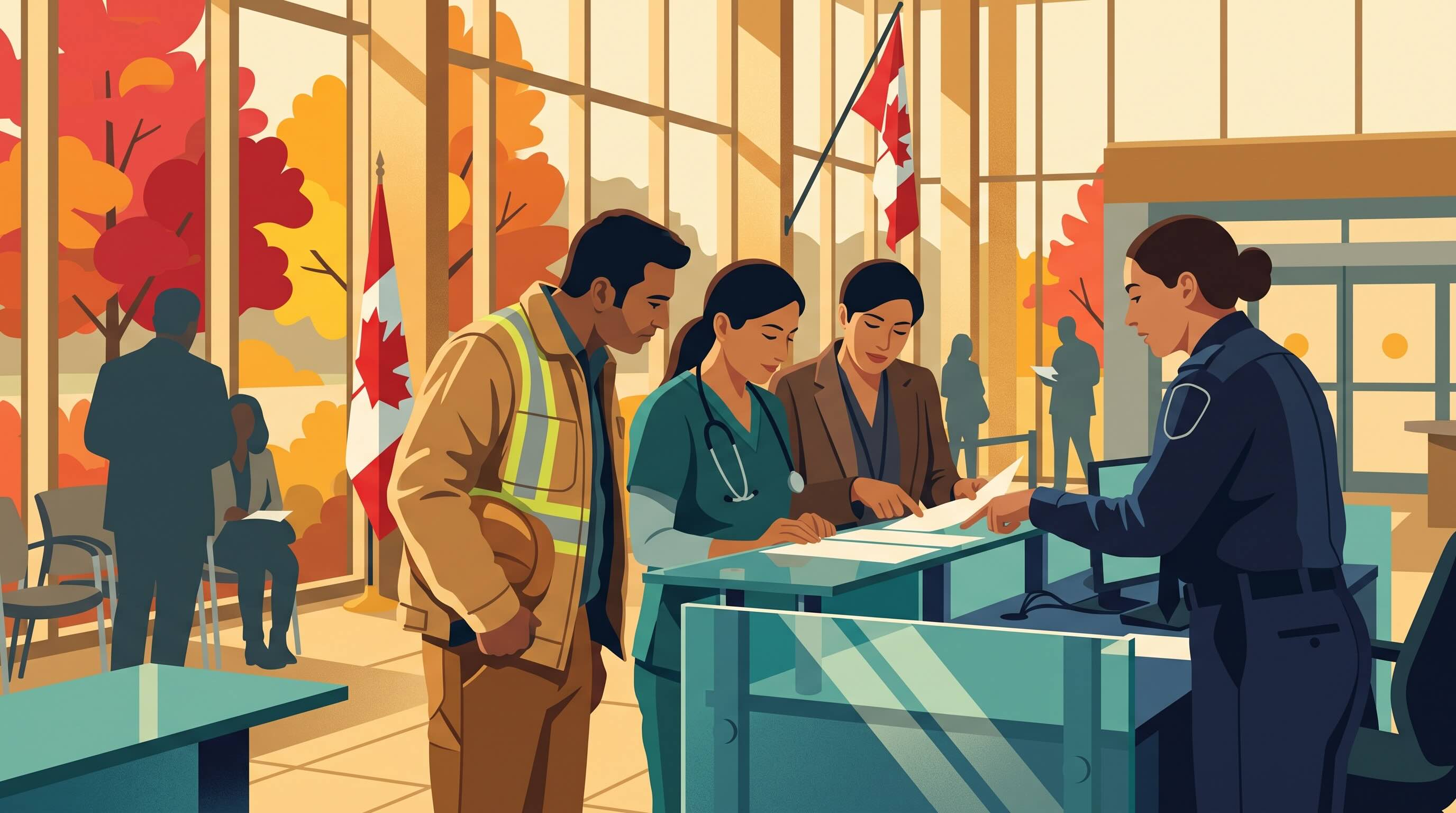
In its policy statement issued the same day, IRCC said the measure is meant to let temporary workers already in Canada, including tradespeople, nurses and laboratory technicians, complete short-term licensing, education or training with a lighter administrative burden, thereby supporting economic growth, filling labour shortages in critical sectors, and backing public services and infrastructure projects. The policy text also notes that helping workers already on the job improve their skills and credentials can help them move into higher-skilled positions and strengthen their prospects for permanent residence (PR), though the measure itself creates no new PR pathway.
How many people are affected
According to the federal government's "Understanding student and temporary worker numbers in Canada" page, the most recent figures at the time of publication are as of June 30, 2026:
- About 1.55 million foreign nationals held a work permit only (1,554,470 to be exact), of whom 252,795 were under the Temporary Foreign Worker Program (TFWP) and 1,301,675 under the International Mobility Program (IMP);
- About 630,000 held a study permit (632,535 to be exact), some of whom also hold a work permit;
- From January to June 2026, new worker arrivals in Canada fell 60 percent compared with the same period in 2024, a decline of 146,865, while new student arrivals fell 82 percent, a decline of 102,520.
The numbers show that while the pool of people the new policy can reach is substantial, it arrives against a backdrop of sharp federal cuts to the temporary resident population. In its policy statement, IRCC reiterated that it will continue to pursue its goal of reducing temporary residents to less than 5 percent of the total population by the end of 2027, and said the focus of this measure is on making better use of workers already in the country rather than on admitting more.