Key numbers from round #437
According to the Ministerial Instructions published by IRCC for round #437, the draw's key parameters were as follows:
| Item | Details |
|---|---|
| Ministerial Instructions number | No. 437 |
| Draw date and time | August 19, 2026, 12:35:37 UTC |
| Category | French-Language proficiency 2026-Version 2 |
| ITAs issued | 5,000 |
| Minimum CRS score | 382 |
| Rank required | Within the top 5,000 of the category |
| Tie-breaking rule | March 1, 2026, 18:34:05 UTC |
| Invitation window | August 19 to August 20, 2026 |
| Eligible programs | FSWP, CEC, FSTP |
The tie-breaking rule determines who is selected when several candidates sit at the cut-off score: priority goes to whoever submitted their Express Entry profile first. Setting the tie-breaker at March 1, 2026 means that only candidates who scored 382 and had a profile in the system before that moment fell within the scope of the invitations.
The instructions also state that the draw's economic objective is to support economic growth through Francophone immigration outside Quebec. Invitations went to candidates ranked within the category, and not to applicants ranked under paragraph 2(d) of the Express Entry instructions — the provincial nominee stream, for which IRCC runs separate PNP-specific draws.
Who qualified for this draw
The French-language proficiency category imposes no occupational restrictions. Its requirements centre instead on language ability and baseline eligibility:
- French-language test results must come from a body designated under subsection 74(3) of the Immigration and Refugee Protection Regulations (such as the TEF or TCF), and must be less than two years old at the time the profile is submitted;
- The candidate must score at least level 7 on the Niveaux de compétence linguistique canadiens (NCLC) in each of the four abilities — listening, speaking, reading and writing;
- The candidate must already be eligible for at least one of the three federal economic programs — FSWP, CEC or FSTP — and must already be in the Express Entry pool.
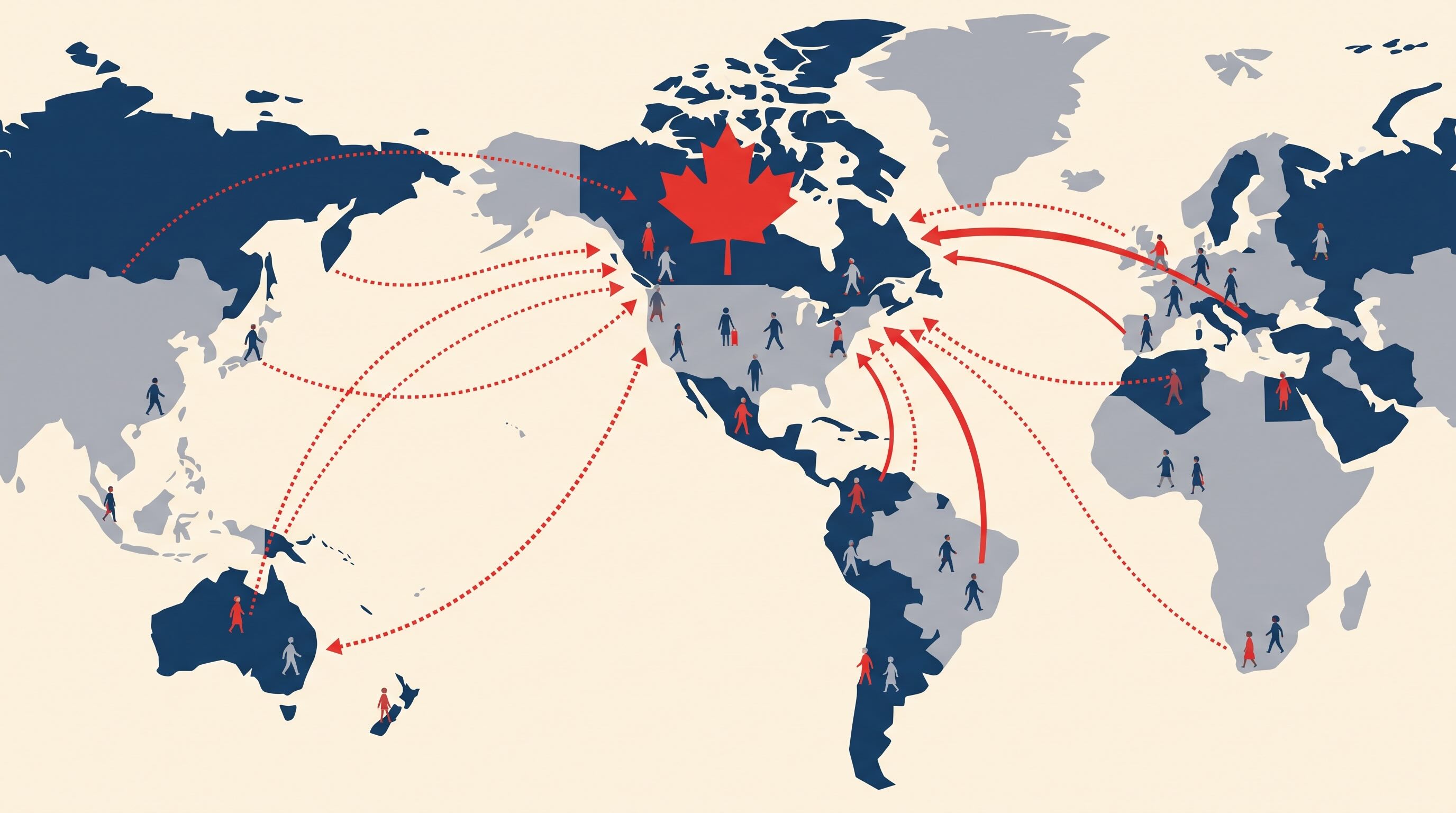
Because the category sets no industry or occupation-code limits, it remains one of the few Express Entry pathways in 2026 that is still broadly open to applicants abroad. IRCC figures compiled by the Canadian immigration resource Moving2Canada show that roughly 78 percent of the ITAs issued in the French category in 2025 went to candidates living outside Canada, the most overseas-oriented profile of any category. By contrast, invitations in the trades and healthcare categories over the same period went mostly to applicants already in Canada.
Three straight cut-off drops as high-scoring Francophone profiles thin out
The 382 cut-off matters because it extends a clear downward curve. On July 9, 2026, round #425 issued 5,000 invitations in the French category at 420 points. Round #429 on July 22 issued another 5,000 at 399. Round #433 on August 6 issued 5,000 more at 391. In this round the size held steady and the cut-off fell a further 9 points.
| Round | Date | ITAs | Minimum CRS |
|---|---|---|---|
| #394 | February 6, 2026 | 8,500 | 400 |
| #401 | March 4, 2026 | 5,500 | 397 |
| #405 | March 18, 2026 | 4,000 | 393 |
| #411 | April 15, 2026 | 4,000 | 419 |
| #414 | April 29, 2026 | 4,000 | 400 |
| #418 | May 28, 2026 | 4,500 | 409 |
| #425 | July 9, 2026 | 5,000 | 420 |
| #429 | July 22, 2026 | 5,000 | 399 |
| #433 | August 6, 2026 | 5,000 | 391 |
| #437 | August 19, 2026 | 5,000 | 382 |
| Total | 50,500 | 382 to 420 |
An even more telling signal comes from the tie-breaking rule. The August 6 draw used a tie-breaker of March 18, 2026 — reaching back roughly four and a half months. This round moved it to March 1, stretching the reach to about five and a half months. In other words, IRCC had to dig further into older, standing profiles to fill 5,000 seats. The immigration news outlet CIC News made a similar argument as early as May 2026: when draw sizes hold steady while cut-offs keep falling and tie-breaking dates keep moving earlier, it usually means the pool's supply of eligible high-scoring Francophone candidates has been substantially consumed.
Looking at the pool as a whole, an August 16, 2026 snapshot compiled by Moving2Canada from IRCC data showed 226,859 candidates in the Express Entry pool, including roughly 48,600 with CRS scores between 351 and 400 — the densest score band, and precisely where this round's 382 cut-off lands. IRCC never publishes the number of French-speaking candidates in the pool separately, so outside observers can only infer it indirectly from cut-off trends and tie-breaking dates.
One caveat is worth stressing: cut-offs do not move in one direction only. Analysts note that each round's threshold depends on how many eligible candidates entered and left the pool since the previous draw, which makes the scores volatile. Francophone candidates planning an application would do better to treat 390 to 420 as the realistic working range rather than anchoring their expectations to the low point of any single round.
Eight months beat a full year: why the French category keeps getting large allocations
Placed in an annual frame, the round's significance is clearer still. Round #437 was the 49th Express Entry draw of 2026 and the tenth dedicated French-language draw of the year. The category's 50,500 ITAs account for more than 40 percent of the roughly 119,865 invitations issued across all Express Entry draws so far in 2026, putting it ahead of the Canadian Experience Class (about 14 rounds and 49,250 ITAs) and in first place among all categories. In all of 2025, by comparison, the French category held 9 rounds and issued 48,000 invitations — a total that 2026 surpassed in eight months.
| Metric | 2025, same period (January 1 to August 19) | 2026, same period | Change |
|---|---|---|---|
| French-category draws | 4 | 10 | Up 6 rounds |
| French-category ITAs | 21,000 | 50,500 | Up about 140% |
| Lowest CRS in period | 379 | 382 | Up 3 points |
| Average ITAs per round | 5,250 | 5,050 | Down about 4% |
The change in cadence is equally visible. In 2025 the French category went nearly five months without a draw between March 21 and August 8. Since July 2026, by contrast, IRCC has settled into a steady rhythm of roughly one French draw every two weeks.
Behind that volume sits an explicit set of policy targets. Following the 2023 overhaul of the Official Languages Act (Bill C-13), Canada is required by statute to adopt and maintain a Francophone immigration policy, with the goal of restoring the demographic weight of Francophone minority communities outside Quebec to the 6.1 percent level recorded in 1971. The Policy on Francophone Immigration, released by IRCC in January 2024, made this a permanent departmental priority, backed by roughly CAD $217.4 million over five years under the Action Plan for Official Languages 2023-2028.
The specific targets rise year over year. Ottawa set Francophone permanent residents outside Quebec at 4.4 percent of admissions for 2023, 6 percent for 2024 and 8.5 percent for 2025; actual results came in at 4.7 percent, 7.21 percent and 8.9 percent respectively, exceeding the target every year. Under the current 2026-2028 Immigration Levels Plan, the target is 9 percent for 2026 (about 30,267 people), 9.5 percent for 2027 (about 31,825) and 10.5 percent for 2028 (about 35,175), with a separate political commitment to reach 12 percent in 2029. IRCC has disclosed that between 2023 and December 2025, the Express Entry French-language category alone issued more than 73,000 invitations.
Admissions space offers a further explanation. The 2026-2028 Immigration Levels Plan sets total permanent resident admissions at 380,000 a year, with the 2026 economic class at 239,800 and the federal high-skilled allocation covering the three Express Entry programs at 109,000. Some analysts argue that if the French category did not maintain its scale, IRCC would have to make up the difference through the Canadian Experience Class, provincial nominees, healthcare or other streams — and CEC rounds have repeatedly shrunk to between 1,000 and 3,000 invitations this year, leaving little room to manoeuvre.
Other shifts in the 2026 category landscape
The French category's heavy volume comes against a backdrop of wholesale changes to Express Entry category-based selection. For 2026, IRCC added five categories: physicians, researchers and senior managers with Canadian work experience, plus transport occupations and skilled military recruits. The agriculture and agri-food category was discontinued. Minimum work experience requirements for most categories also rose from 6 months to 12 months, full-time or the equivalent, and need not be continuous within the three-year lookback period.
Actual execution this year has varied enormously between categories. Healthcare and social services held 2 rounds for 8,000 invitations; trades held 1 round for 3,000; senior managers held 2 rounds for 750; physicians held 2 rounds for 662; transport held 1 round for 300; and skilled military recruits held 1 round that issued just 4 invitations. The provincial nominee stream ran 16 rounds but issued only 7,399 invitations in total, with cut-offs sitting persistently above 700. Neither an education category draw nor a general draw has been held so far in 2026 — gaps worth continuing to watch.
The wild card: a CRS overhaul that would cut French-language points
Even as the French category surges, a reform that could reshape the landscape is taking form. IRCC released details of its Express Entry overhaul in April 2026 and ran a public consultation in the spring of 2026. Under the publicly disclosed proposal, the FSWP, FSTP and CEC would be merged into a single program; a new "high-paying occupation" factor would award points based on an occupation's earnings relative to the national median; and points for an employer job offer would be conditionally restored. At the same time, the factors slated for removal or reduction include the existing French-language points (25 to 50 points), points for Canadian educational credentials, points for a sibling in Canada, spousal factors and the 600 points attached to a provincial nomination. IRCC's stated rationale is that French-language points are a weak predictor of an applicant's later economic outcomes.
It bears emphasising that all of this remains at the proposal and consultation stage: there is no draft regulation and no implementation timetable, and it is not settled whether category-based draws will survive at all. IRCC had already eliminated the 50-point and 200-point bonuses for arranged employment — including LMIA-supported job offers — on March 25, 2025. Officials described that step as a temporary measure at the time but have yet to say when it will end, an illustration of how such adjustments often outlast their originally advertised duration.
For Francophone candidates, this creates a concrete question of timing. Under current rules, French-language ability remains the highest-leverage single factor in Express Entry, with French draw cut-offs frequently more than 100 points below those of Canadian Experience Class rounds. If the reform lands and French-language points are cut, CRS scores across the standing pool of candidates would fall broadly.
What to watch next
Francophone candidates already in the pool should keep several dates in view:
- The next French-language draw. IRCC does not announce its draw schedule in advance, but at the roughly biweekly cadence in place since July 2026, industry observers broadly expect another French round in early September.
- The 2027-2029 Immigration Levels Plan. Public consultation closed on June 30, 2026, and the plan must be tabled in Parliament by November 1, 2026 under the Immigration and Refugee Protection Act. It is expected in November and will set a Francophone admissions target for 2029 for the first time.
- Legislative progress on the Express Entry reform. The consultation has closed, but no draft regulations or coming-into-force date have been published — the decisive factor in whether French-language points survive.
- The second annual review of the Policy on Francophone Immigration. Scheduled for completion during 2026, it may signal how hard Ottawa intends to push in the next phase.
For candidates scoring between 380 and 420 who already hold NCLC level 7 French, this remains a relatively favourable window by recent standards. Those who have yet to sit a French test, meanwhile, need to build the uncertainty surrounding the reform into their own planning horizon.