A 37-day extension, explained in a single sentence
In a news notice updated August 13, the BC PNP said TRHSI registrations will be "accepted until 11:59 pm on October 7, 2026," adding only that "this extension is being made to account for any wildfire-related impacts." Measured against the original cut-off of 11:59 pm on August 31, 2026, the window has been stretched by exactly 37 days.
Applicants should note the wording carefully. The official deadline is 11:59 pm Pacific time on October 7 — not midnight, and not the early hours of October 8. Submissions should be completed well before that moment rather than pushed to the final minutes.
The province did not issue a separate release through its government newsroom, and no minister or senior official spoke publicly about the change; the news appeared only in the BC PNP's program news section. That is consistent with how the initiative has been handled throughout: the June 15 registration opening and a June 10 information session were both announced in the same low-key channel.
How a wildfire season reached into an immigration program
The wildfire reference is not boilerplate. On August 8, 2026, after the Bald Range fire in the South Okanagan grew explosively overnight, destroying homes and triggering mass evacuations, B.C. declared a provincewide state of emergency, with more than 20,000 people forced to leave their homes. Premier David Eby said at the time that "the conditions of this fire are extremely dangerous and are changing minute by minute."
The season-to-date numbers underline the scale. As of August 10, B.C. had recorded 901 wildfires this season, burning 388,962 hectares, with 1,724 firefighting personnel deployed. By August 14, the Bald Range fire alone had reached 19,149 hectares and remained out of control, more than 6,000 properties across three regional districts were still under evacuation order, and 112 fires were burning actively across the province.
The impact on rural health facilities is already concrete. Because of the Bald Range fire, Interior Health evacuated residents from two care facilities in Summerland — 48 residents from Dr. Andrew Pavillion and 190 from Summerland Seniors Village, more than 230 people in total — while Penticton Regional Hospital kept emergency services running. The workers TRHSI is designed for are precisely the cleaners and security guards who keep facilities like these operating day to day. When their communities are under evacuation order and their employers are consumed by emergency logistics, applicants can neither secure employer cooperation nor find time to assemble a registration — which is the practical reason behind the extension.
There is federal precedent of a kind. Immigration, Refugees and Citizenship Canada (IRCC) introduced temporary measures for people affected by the 2024 wildfires, waiving document replacement fees and easing extensions and restorations of temporary resident status; those measures ended on November 30, 2024. A provincial nominee program extending a category's registration window because of fire, however, remains unusual.
A 50-point cut-off — the year's lowest — with about 190 spots still to go
Since registration opened on June 15, TRHSI has held exactly one draw. According to the BC PNP's official invitation records, the stream issued 60 ITAs on July 23, 2026 at a minimum score of 50 points — the lowest cut-off recorded in any BC PNP category so far in 2026.
The significance of that number becomes clear only alongside the other categories drawing over the same period:
| Draw date | Category | Minimum score | Invitations issued |
|---|---|---|---|
| May 6, 2026 | Care: Health | 108 | 117 |
| June 2, 2026 | Care: Health | 100 | 117 |
| July 9, 2026 | Care: Health | 96 | 116 |
| August 6, 2026 | Care: Health | 84 | 124 |
| August 6, 2026 | Care: Childcare | 102 | 183 |
| August 6, 2026 | Build: Construction Trades | 88 | 187 |
| July 16, 2026 | Innovate: High Economic Impact (points-based) | 132 | 346 |
| July 23, 2026 | TRHSI | 50 | 60 |
Even Care: Health, whose cut-off has fallen steadily through the year, still sat at 84 points on August 6 — a full 34 points above TRHSI. The Innovate stream aimed at high-economic-impact talent went out at 132 points in its July 16 points-based draw. A BC PNP snapshot of the registration pool adds further context: as of August 4, 2026, the Skills Immigration pool held 8,306 candidates, of whom only 212, or about 2.6 per cent, scored 59 points or below. In other words, a 50-point threshold sits far below where the BC PNP scoring system does its filtering; what actually screens applicants here is eligibility itself, not score competition.
Against the 250-nomination ceiling, 60 invitations account for roughly 24 per cent of the total, leaving about 190 nominations to be issued within the extended window. The BC PNP does not publish a draw calendar, and no date has been announced for the next TRHSI round.
Who qualifies: three occupations, eight employers, nine continuous months
TRHSI sets an extraordinarily low bar on points and an extraordinarily specific one on employment and geography. The core parameters:
| Item | Detail |
|---|---|
| Registration opened | June 15, 2026 |
| Original registration deadline | 11:59 pm, August 31, 2026 |
| New registration deadline | 11:59 pm, October 7, 2026 |
| Extension announced | August 13, 2026 |
| Length of extension | 37 days |
| Nomination cap | 250 |
| Invitations issued | 60 (as of August 15, 2026) |
| Nominations remaining | About 190 |
| Eligible occupations | NOC 65312, NOC 65310, NOC 64410 |
| Eligible employers | B.C.'s eight public health authorities |
| Work experience requirement | Nine continuous months of full-time work with the same health authority |
Only three National Occupational Classification (NOC) codes qualify:
- Janitors, caretakers and heavy-duty cleaners (NOC 65312)
- Light duty cleaners (NOC 65310)
- Security guards and related security service occupations (NOC 64410)
Geographically, the job must be located in an eligible rural or remote area — meaning anywhere outside the Central Okanagan Regional District, the Metro Vancouver Regional District and the Capital Regional District. The Capital Regional District carries carve-outs: Galiano Island, Mayne Island, Pender Island, Salt Spring Island and Saturna Island all remain eligible.
On the employer side, candidates must work for one of B.C.'s eight public health authorities:
- First Nations Health Authority
- Fraser Health
- Interior Health
- Island Health
- Northern Health
- Providence Health Care
- Provincial Health Services Authority
- Vancouver Coastal Health
Each health authority runs its own internal process for deciding which provincial nomination applications it will support, and none is obliged to support a BC PNP application at all. Meeting every published criterion, in other words, still leaves an applicant dependent on their employer's cooperation.
The work experience rule is stricter than the commonly repeated shorthand of "nine months" suggests. Candidates must have worked full time — at least 30 hours per week — in an eligible occupation for the same health authority employer for nine continuous months immediately before registering, not nine months accumulated over time. Work performed as part of a co-op or other study program, work done on a study permit, and any leave longer than two weeks all fail to count. Applicants must also have completed secondary school (holding a high school diploma) and have met the minimum income requirement continuously across the full nine-month period before registering and applying, in addition to the general requirements for Skills Immigration candidates. Full eligibility rules are set out in the BC PNP's Skills Immigration (SI) guide.
Successful candidates receive a Confirmation of Nomination and can apply to the federal government for permanent residence under the provincial nominee class, together with accompanying family members. One limitation is worth flagging: TRHSI does not run through B.C.'s Express Entry stream, so applications follow the base BC PNP route and get no federal processing acceleration.
Immigration practitioners point out that the binding constraint on TRHSI is neither score nor language but the employment relationship itself. Cleaners and security guards employed through outside contractors do not qualify — and contracting out hospital cleaning and security is widespread across the sector, which sharply narrows the pool of workers who can actually benefit.
From shutting low-skilled streams to opening one narrow, time-limited door
To understand why TRHSI exists in this time-limited, capped, occupation-restricted form, it helps to go back to the BC PNP's April 2026 overhaul.
On April 23, 2026, the BC PNP published its program priorities and updates, restructuring Skills Immigration around three streams: Care (health care, education, childcare and veterinary work), Build (infrastructure and skilled trades) and Innovate (top talent across sectors). Care covers 36 in-demand occupations; Build covers nine priority in-demand trades. Several older pathways closed at the same time. The Entry Level and Semi-Skilled (ELSS) category serving tourism, hospitality and food processing was formally shut down, its final invitation round having been held on December 10, 2024. Three planned student categories at the bachelor's, master's and doctoral levels were scrapped, while the International Graduate and International Post-Graduate streams closed in November 2025 and January 2025 respectively. Priority Tech draws ended, with tech talent folded into Innovate: High Economic Impact. The reform also set a regional target: at least 35 per cent of nominations are to go to candidates who work and live outside Metro Vancouver.
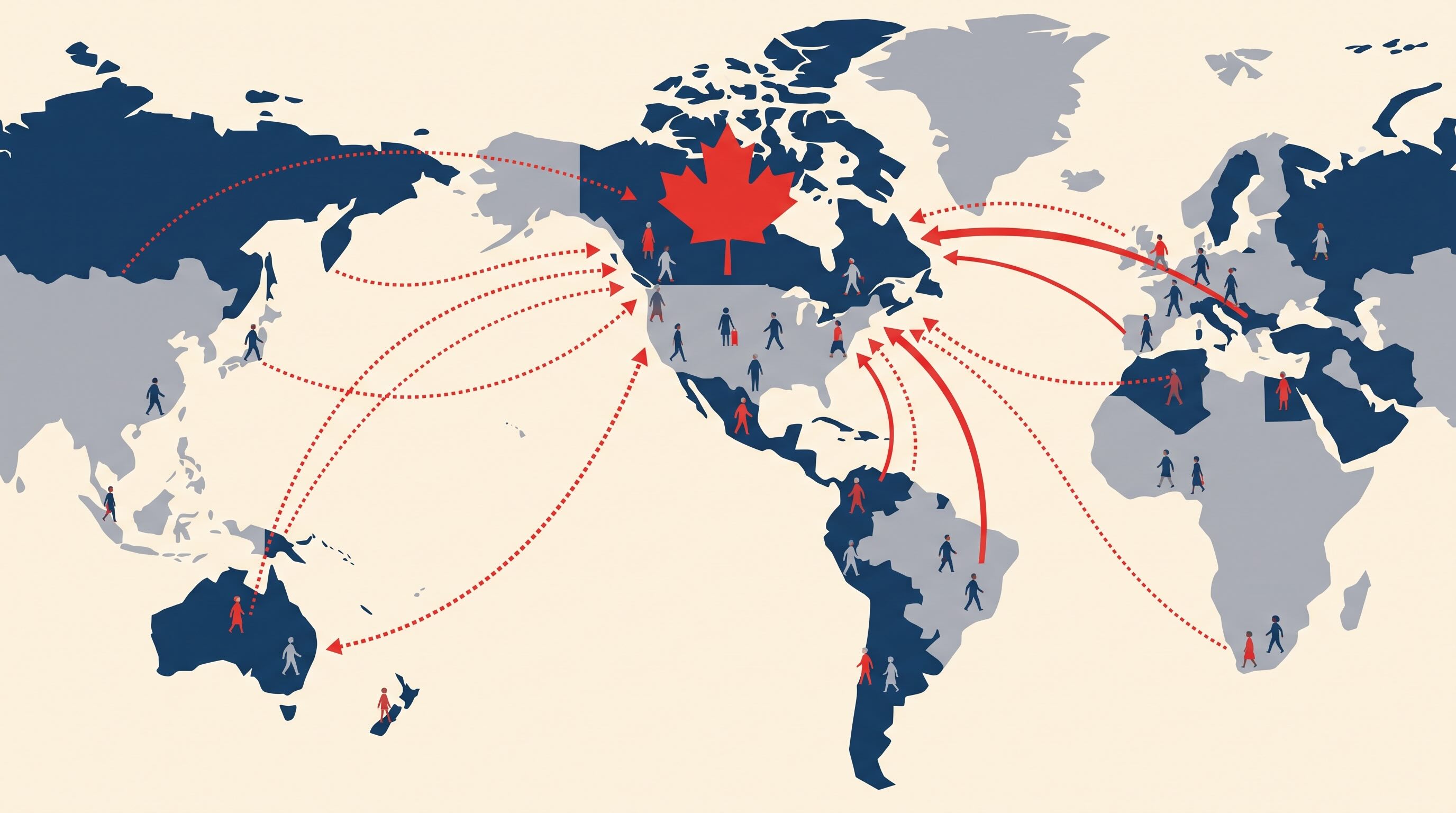
Within that framework — a decisive tilt toward higher skills and a deliberate narrowing of entry points — TRHSI stands out as the exception. It is the only post-reform pathway aimed at TEER 5 lower-skilled roles, and the only one with an explicit time limit and hard cap. The prevailing read in Canadian immigration media is that it is both a targeted response to real staffing needs in the rural health system and an echo of pressure at the federal level, where a coalition of chambers of commerce has written to Ottawa calling for a permanent pathway for lower-skilled workers.
The BC PNP also maintains a standing Health Authority category for licensed professionals such as dentists, pharmacists and nurses, who can apply directly without registering. The contrast is instructive: the standing category serves credentialed professionals, while TRHSI recognizes support roles that are almost never given a PR pathway at all.
Tighter allocations meet a rural health staffing squeeze
TRHSI's 250 nominations have to be read against a provincial allocation that has been cut hard.
In 2024, B.C. received a federal allocation of 8,000 nominations and used every one. In early 2025 Ottawa cut that to 4,000 — an exact halving — against the 11,000 B.C. had requested. The province said at the time that 4,000 spaces would allow it to accept only about 1,100 new applications for the full year, with the rest absorbed by the existing backlog. After two in-year top-ups, the 2025 total recovered to 6,214. For 2026, B.C. became the first province to publish its annual allocation, receiving 5,254 nominations — roughly 31 per cent above the early-2025 figure of 4,000, but still below the topped-up 6,214 of 2025. B.C. had asked for 9,000, leaving a shortfall of 41.6 per cent.
Federal direction, meanwhile, is swinging the other way. The 2026-2028 Immigration Levels Plan raises the permanent resident admissions target for the Provincial Nominee Program from 55,000 in 2025 to 91,500 in 2026, an increase of about 66 per cent, while cutting the Temporary Foreign Worker Program target from 82,000 to 60,000 and study permits from 305,900 to 155,000. It is worth distinguishing the two measures: 91,500 is a federal landings target, not the same thing as the nomination allocations handed to individual provinces.
The human cost of tighter allocations shows up most directly in health support roles. The Hospital Employees' Union (HEU) warned in early 2025 that more than 500 of its members at Fraser Health and Vancouver Coastal Health faced having to leave the country that year, across care aide, cleaning, dietary and clerical support positions. HEU secretary-business manager Lynn Bueckert criticized Ottawa's 2024 changes to the Provincial Nominee Program, saying they abandoned these health care workers at a time when they are needed most. By late 2025, media reported that roughly 400 health care workers at the two authorities had work permits expiring within the year.
On a longer view, Statistics Canada data show the number of temporary foreign workers in Canada's health care sector rising from 3,200 in 2000 to 57,500 in 2022 — an increase of roughly 17 times. By 2022, more than 80 per cent of temporary foreign workers in long-term care and residential care settings held permits tied to non-health occupations, typically support roles such as care aides, orderlies and patient service associates. Ontario, B.C. and Quebec together employ 82 per cent of the country's temporary foreign workers in health care.
The BC PNP is administered by the Ministry of Post-Secondary Education and Future Skills. Discussing allocation uncertainty in late 2025, Minister Jessie Sunner said bluntly, "It's a guessing game right now," adding that health care professionals would be prioritized once the federal allocation was confirmed. On April 20 of this year, the ministry separately announced that rural employers outside census metropolitan areas would be allowed to keep existing low-wage temporary foreign workers above the 10 per cent cap for another year, while declining to adopt Ottawa's higher 15 per cent low-wage cap; about 585 employers outside metropolitan areas currently exceed the threshold. That decision and TRHSI point at the same underlying problem: rural B.C. cannot hold on to workers.
For eligible candidates, the 37 days to October 7 represent a window that requires no competition against high-scoring applicants but imposes demanding conditions on employment and location. Whether the roughly 190 unissued nominations get used will depend on how many cleaners and security guards employed directly by a health authority, with nine continuous months of work in an eligible region behind them, manage to register before the window closes.